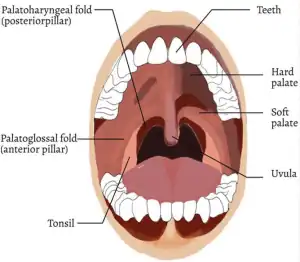
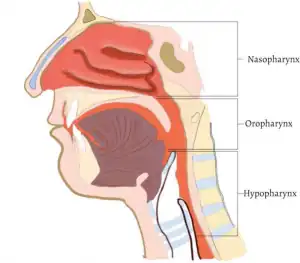
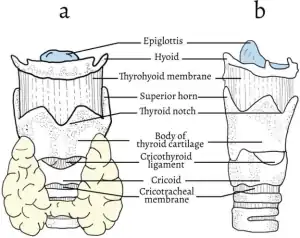
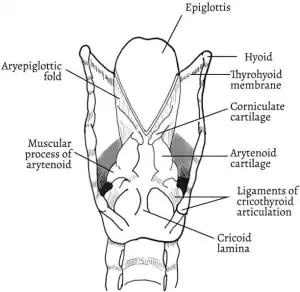
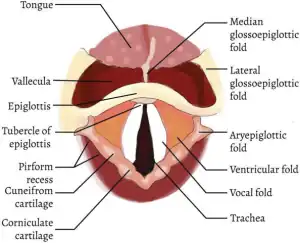
Oral cavity and oropharynx.Sagittal section through the head and neck showing the subdivisions of the pharynx.External views of the larynx: (a) anterior aspect; (b) anterolateral aspect with the thyroid gland and cricothyroid ligament removed.The cartilages and ligaments of the larynx seen posteriorly.Larynx as visualized from the hypopharynx.
Two most common devices are the C-MAC and the Glidescope[1]
Both CMAC and Glidescope systems offer both hyperangulated and standard geometry blades
Increasingly utilized in emergency airway management[2]
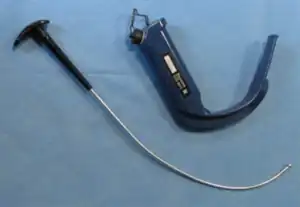
Hyperangulated blade and rigid stylet typical of the Glidescope video laryngoscopeThe C-MAC video laryngoscope (pictured above) has a Macintosh or "standard geometry" blade similar to that of a Macintosh direct laryngoscope (pictured below).
Hyperangulated video laryngoscope
Patient ideally in neutral spine position (as opposed to "sniffing" position for direct laryngoscopy)
After induction, use right hand to "scissor" mouth open
Place hyperangulated blade midline and slowly advance with progressive identification of airway landmarks
Advance blade into vallecula
When cords fill entire screen (Cormack-Lehane Grade I), slightly retract laryngoscopy so that cords only occupy upper 1/3 of screen (CL Grade II, allows for passage of ETT with rigid stylet)[3]
If intubation is attempted with the best view possible, operators often have difficulty advancing the tube around the tongue and hypopharyngeal soft tissues
↑Peterson K, Ginglen JG, Valenzuela FI, et al. Direct Laryngoscopy. [Updated 2020 Mar 31]. In: StatPearls [Internet]. Treasure Island (FL): StatPearls Publishing; 2020 Jan-. Available from: https://www.ncbi.nlm.nih.gov/books/NBK513224/[Category:Procedures]]
↑Brown CA 3rd, Bair AE, Pallin DJ, Walls RM; NEAR III Investigators. Techniques, success, and adverse events of emergency department adult intubations [published correction appears in Ann Emerg Med. 2017 May;69(5):540]. Ann Emerg Med. 2015;65(4):363-370.e1. doi:10.1016/j.annemergmed.2014.10.036
↑Gu Y, Robert J, Kovacs G, et al. A deliberately restricted laryngeal view with the GlideScope® video laryngoscope is associated with faster and easier tracheal intubation when compared with a full glottic view: a randomized clinical trial. Une vue laryngée délibérément restreinte à l'aide du vidéolaryngoscope GlideScope® est associée à une intubation trachéale plus rapide et plus aisée qu'une vue glottique totale: une étude clinique randomisée. Can J Anaesth. 2016;63(8):928-937. doi:10.1007/s12630-016-0654-6
↑Je, S. M., Kim, M. J., Chung, S. P., & Chung, H. S. (2012). Comparison of GlideScope® versus Macintosh laryngoscope for the removal of a hypopharyngeal foreign body: A randomized cross-over cadaver study. Resuscitation, 83(10), 1277–1280.