Meckel's diverticulum
<languages/> <translate>
Background
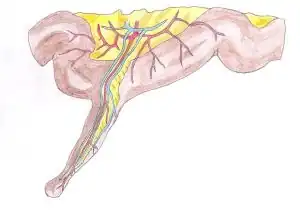
- Most common cause of significant lower gastrointestinal bleeding in children[1]
- Most common congenital abnormality of the small intestine
- Caused by incomplete involution of vitelline duct (occurs by 7 weeks)
- Blind-ending true diverticulum that contains all layers found in the ileum
Rule of 2's
- 2% of population
- 2 feet from ileocecal valve
- 2 inches long
- 2% become symptomatic
- 2 years of age (45%)
- 2 times more common in boys
- 2 types of epithelium (gastric/pancreatic)
Clinical presentation
- Rectal bleeding (+/- pain)
- Most common presentation in <5yrs
- May be intermittent or massive
- Obstruction (due to intussusception or volvulus)
- May lead to bowel ischemia, shock
- Diverticulitis
- Umbilical fistula
- 1/3 will perforate
- Traumatic rupture after blunt trauma possible
Differential Diagnosis
</translate>
Undifferentiated lower gastrointestinal bleeding
- Upper GI Bleeding
- Diverticular disease
- Vascular ectasia / angiodysplasia
- Inflammatory bowel disease
- Infectious colitis
- Mesenteric Ischemia / ischemic colitis
- Meckel's diverticulum
- Colorectal cancer / polyps
- Hemorrhoids
- Aortoenteric fistula
- Nearly 100% mortality if untreated
- Consider in patients with gastrointestinal bleeding and known abdominal aortic aneurysms or aortic grafts
- Rectal foreign body
- Rectal ulcer (HIV, Syphilis, STI)
- Anal fissure
<translate>
Evaluation
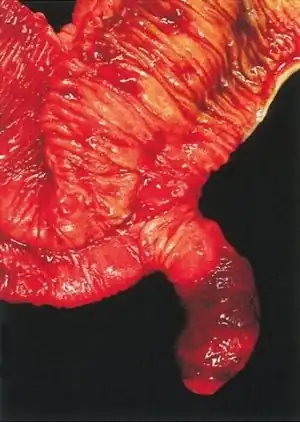
Workup
- Meckel's scan (test of choice), also known as technetium-99m pertechnetate scan
Diagnosis
Management
- NGT
- Broad-spectrum antibiotics
- IVF
- pRBCs PRN
- Surgery consult
See Also
- Abdominal pain (peds)
External Links
References
</translate>
- ↑ Sagar J, et al. Meckel diverticulum: a systematic review. J R Soc Med. 2006;99(10):501-505. PMID 17021300