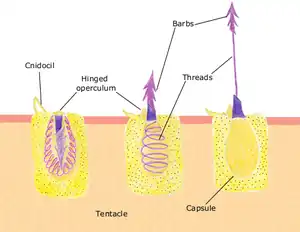
Location is worldwide (excluding Hawaii) in reefs & shallow waters.[1]
White to yellow-green appearance that are fixed to rocks and coral.[2]
They possess tentacles that extend upward & are roughly 2m in length.[3]
Fire corals (Millepora) are a genus of colonial marine organisms that exhibit physical characteristics similar to that of coral. The name coral is somewhat misleading, as fire corals are not true corals but are instead more closely related to Hydra and other hydrozoans, making them hydrocorals.
↑Hauglid, Christopher, DO, et al. “EMERGEN-SEA MEDICINE: An Overview of Sea Urchins, Coral, Starfish, and More.” ACEP Now, vol. 40, no. 7, 2021, pp. 8–9.
↑Hauglid, Christopher, DO, et al. “EMERGEN-SEA MEDICINE: An Overview of Sea Urchins, Coral, Starfish, and More.” ACEP Now, vol. 40, no. 7, 2021, pp. 8–9.
↑Hauglid, Christopher, DO, et al. “EMERGEN-SEA MEDICINE: An Overview of Sea Urchins, Coral, Starfish, and More.” ACEP Now, vol. 40, no. 7, 2021, pp. 8–9.
↑Hauglid, Christopher, DO, et al. “EMERGEN-SEA MEDICINE: An Overview of Sea Urchins, Coral, Starfish, and More.” ACEP Now, vol. 40, no. 7, 2021, pp. 8–9.
↑Hauglid, Christopher, DO, et al. “EMERGEN-SEA MEDICINE: An Overview of Sea Urchins, Coral, Starfish, and More.” ACEP Now, vol. 40, no. 7, 2021, pp. 8–9.
↑Hauglid, Christopher, DO, et al. “EMERGEN-SEA MEDICINE: An Overview of Sea Urchins, Coral, Starfish, and More.” ACEP Now, vol. 40, no. 7, 2021, pp. 8–9.
↑Hauglid, Christopher, DO, et al. “EMERGEN-SEA MEDICINE: An Overview of Sea Urchins, Coral, Starfish, and More.” ACEP Now, vol. 40, no. 7, 2021, pp. 8–9.
↑Hauglid, Christopher, DO, et al. “EMERGEN-SEA MEDICINE: An Overview of Sea Urchins, Coral, Starfish, and More.” ACEP Now, vol. 40, no. 7, 2021, pp. 8–9.