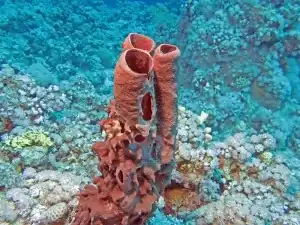
Generally stationary and attach to see floor or coral beds
Relevant species
Most common Tedania ignis (Hawaiian or West Indian fire sponge)
Found in Florida and Hawaii
Fibula nolitangere (poison bun sponge)
Microciona prolifera (red moss sponge)
Clinical Features
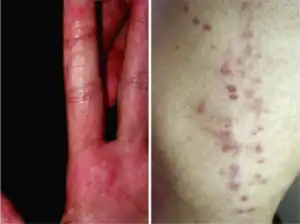
Left: eczema-like plaques on the hand after known marinesponge exposure. Right: disseminated excoriated papules in a swimmer after diving in a lake in the Amazon region.
Symptoms caused by contact with sponge
Reaction appears between 10 minutes and a few hours of contact
Auerbach PS, DiTullio AE. Envenomation by Aquatic Invertebrates. In Auerbach PS, Cushing TA, Harris NS. Auerbach’s Wilderness Medicine. 7th ed. Philadelphia, PA: Elsevier; 2017: 1679 – 1682.
↑Hauglid, Christopher, DO, et al. “EMERGEN-SEA MEDICINE: An Overview of Sea Urchins, Coral, Starfish, and More.” ACEP Now, vol. 40, no. 7, 2021, pp. 8–9.
↑Hauglid, Christopher, DO, et al. “EMERGEN-SEA MEDICINE: An Overview of Sea Urchins, Coral, Starfish, and More.” ACEP Now, vol. 40, no. 7, 2021, pp. 8–9.