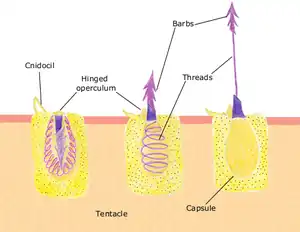
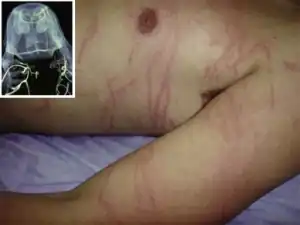
Usually develops within 2 hours of envenomation & can last up to 2 days
Rare but potentially fatal complication. It often involves intense pain, diffuse muscle cramps, vasconstriction and marked hypertension due to a catacholamine surge.
Beware of hypertensive emergency: Look for signs of end organ damage (ie ACS, CHF, intracranial hemorrhage, renal injury)
Hot salt water immersion (inactivates heat labile toxins), submerging the area in 45 ℃ water for 20 minutes has been shown to provide significant pain relief[2]
Stingose is a topical solution composed of 20% aluminum sulfate and 1.1% surfactant.
Used for pain control, venom removal via osmosis, & venom neutralization via denaturation of proteins and polysaccharides through interactions with the aluminum ion.[3]
Ward NT, Darracq MA, Tomaszewski C, et al. Evidence based treatment of jellyfish stings in North America and Hawaii. Ann Emerg Med. 2012;60(4):339-414.
Cegolon L, Heymann WC, Lange JH, et al. Jellyfish stings and their management: a review. Mar Drugs. 2013;11(2): 523-50
↑#Isbister GK, Currie BJ. Hot water immersion v icepacks for treating pain of Chironex fleckeri stings: a randomised controlled trial. Med J Aust. 2017 Oct 16;207(8):362. PubMed PMID: 29020913.
↑Yanagihara AA, Wilcox CL. Cubozoan Sting-Site Seawater Rinse, Scraping, and Ice Can Increase Venom Load: Upending Current First Aid Recommendations. Toxins (Basel). 2017;9(3):105. Published 2017 Mar 15. doi:10.3390/toxins9030105
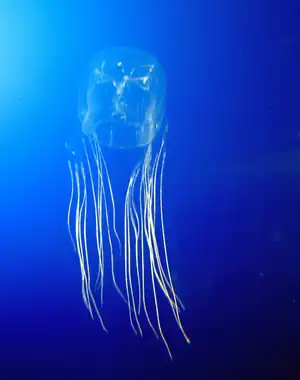
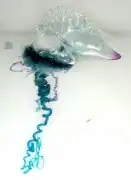 Portuguese Man-O-War {Physalia physalis)
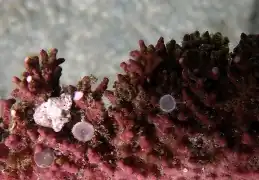
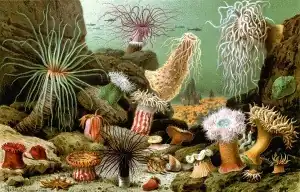 A selection of various sea anemones