Odontoid fracture
Background
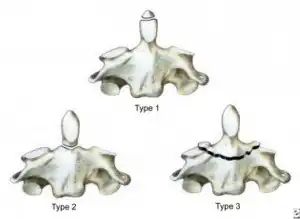
- Fracture of C2 (dens)
- Bimodal age distribution
- Young - injury secondary to blunt trauma to head or flexion/extension injury
- Elderly - injury secondary to fall, higher morbidity/mortality than young patients
- Increased risk of fracture due to bone loss, which is disproportionate at C2 relative to rest of skeleton
- Frequently associated with other cervical spine injuries
- 25% associated with neurologic injury/deficit
- Os odontoideum (normal variant) can look like a Type II odontoid fracture on imaging, causing false postive
Types
- Type I: Oblique avulsion fracture of tip of odontoid; alar ligament avulsion
- Stable fracture
- Type II: Fracture at base of odontoid where it meets C2 body
- Unstable fracture
- High risk of nonunion (30%) due to interruption of blood supply
- Type III: Extension of the fracture through upper portion of body of C2
- Unstable fracture
Vertebral fractures and dislocations types
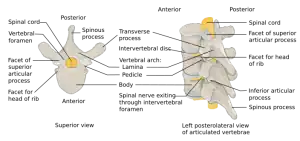
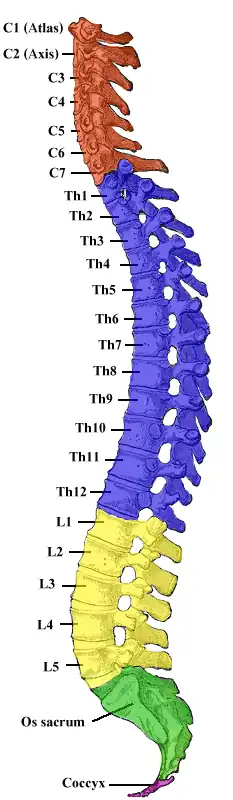
- Cervical fractures and dislocations
- Thoracic and lumbar fractures and dislocations
Clinical Features
- Neck pain
- May have neurologic deficit
Differential Diagnosis
<translate>
Neck Trauma
- Penetrating neck trauma
- Blunt neck trauma
- Blunt cerebrovascular injury (BCVI)
- Vertebral artery dissection
- Carotid artery dissection
- Blunt laryngeal trauma
- Whiplash injury
- Blunt cerebrovascular injury (BCVI)
- Strangulation
- Hanging and near-hanging
- Cervical spine injury
- Cervical fractures and dislocations
- Atlanto-occipital dissociation
- Cervical injury (peds)
- Cervical spine clearance
- Spinal cord injury
- Spinal cord injury
- Incomplete spinal cord syndromes
- Central cord syndrome
- Anterior cord syndrome
- Brown-Séquard syndrome
- SCIWORA
- Neurogenic shock
</translate>
Evaluation
- CT is the imaging study of choice
- Cervical spine x-ray may be performed if CT unavailable
- Must include open-mouth odontoid view
Management
- Cervical spine motion restriction via hard cervical collar
- Consult spine surgery
Disposition
- Admit
- May consider discharge with hard cervical collar for Type I fracture (stable)
- Consider only in consultation with spine surgery service[1]
See Also
References
- ↑ Waterbrook, A. (2016). Sports medicine for the emergency physician: a practical handbook. Cambridge: Cambridge University Press.