Thoracic burst fracture
Background
- Mechanism: axial loading with flexion compromising anterior and middle column
- Retropulsion of bone causes damage to the spinal canal and neurologic deficits that often cause stable neurologic deterioration.
- Can occur with or without injury to posterior elements (posterior involvement increases risk for neuro deficits)
- Be certain not to mistakenly call a burst fracture a wedge fracture
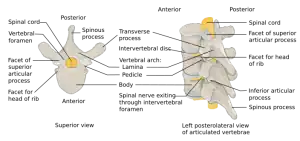 Vertebral anatomy.
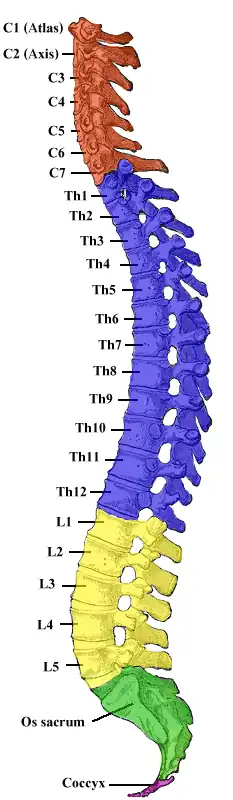 Numbering order of vertebrae.
Clinical Features
Differential Diagnosis
- Airway/Pulmonary
- Cardiac/Vascular
- Musculoskeletal
- Other
Workup
- Obtain CT if unsure (vs. wedge)
Management
- Consult Orthopedics or Neurosurgery (Institution dependent)
- Depending on neurologic symptoms and features of the fracture- can be managed nonoperatively
Disposition
See Also
External Links
References