Nonaccidental trauma
Background Newer term that encompasses child abuse
Infant and children with disabilities are at higher risk
In >80% of cases, the parent or primary guardian is the abuser
Report suspicion
Transparent, frank discussion with caregivers
Social work or child protection agency involvement
Protect the child first, admit if suspicious
Social work may follow-up as outpatient for very low risk cases Risk Factors Red flags History given is inconsistent with the mechanism of injury
Changes in caregivers report
Significant delays in care
Any injury to a young, pre-ambulatory infant
Injuries to multiple organ systems
Injuries in different stages of healing;
Patterned injuries
Injuries to non-bony or other unusual locations, (torso, ears, face, neck, or upper arms)
Significant injuries that are unexplained
Other evidence of child neglect. Clinical Features Bruises Bruises, ecchymosis, and soft-tissue injuries on the face, cheeks, buttocks, ears, torso, neck if the child is not cruising yet
Bruises in clusters or patterned marks
Bruising of any child less than or equal to 6 months of age (or non-ambulatory) warrants a full child abuse work-up Oral injuries Torn frenulum in premobile children is highly associated with physical abuse
Other reported oral injuries include laceration/bruising to the lips , mucosal lacerations, dental trauma , tongue injuries , and gingival lesions Most commonly immersion injuries of the extremities, buttocks, or perineum
More likely symmetrical with clear upper margins
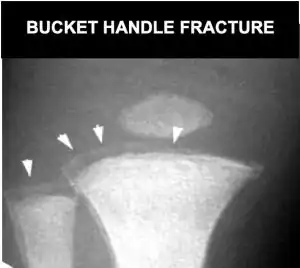
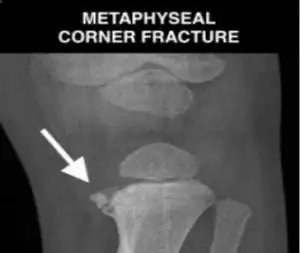
Many will also have occult fractures; children <24mo should undergo a skeletal survey Fractures Bucket Handle Fracture (Courtesy of Michael Mojica[ 1] Metaphyseal Chip Fracture (Courtesy of Michael Mojica) Fractures highly suspicious of abuse:
Rib fracture , especially posteriorMetaphyseal or Corner Fracture (Bucket Handle)
Scapula fracture Spinous process fractures
Sternum fracture Fracture not consistent with developmental stage (any fracture in non-ambulatory child) Fractures moderately suspicious of abuse:
Long-bone transverse or spiral fracture of the diaphysis of the femur , humerus , tibia
Multiple bilateral fractures
Different stages of healing with multiple fractures
Epiphyseal separations
Vertebral body separation
Complex skull fractures (i.e. depressed or cross suture lines)
Pelvic fractures Leading cause of death in abused children <2 years old
Shaken baby syndrome - Retinal hemorrhages
Present in up to 75% of cases and are virtually pathognomonic
Described as “dot and blot” hemorrhages or flame or splinter hemorrhages Most from a direct blow or from being thrown
Any abrasion or bruise on the abdominal area should prompt an evaluation for possible trauma
Consider abuse in preschool aged children with any hollow viscus or pancreatic injury Even among children who report vaginal or anal penetration, the rate of abnormal physical examination findings is only 5 to 15%
Consult your local sexual assault response team or transfer to an appropriate facility as indicated.
Females
Preferred positioning for adequate examination: child lying supine with her hips externally rotated and knees flexed (frog-leg) or the prone knee-chest position.
Examine hymen for lacerations, transections, and bruising.
Prepubertal females do not require a speculum exam unless there is active bleeding.
Vaginal discharge in a prepubertal female should prompt testing for sexually transmitted infections.
The diameter of the hymenal orifice is not a marker for whether or not vaginal penetration occurred.
Males
Examine for lacerations, burns, bite marks, and bruises to the genital region. Penile and anal injuries are more common than scrotal injuries.
Swab any anal or penile discharge for sexually transmitted infections. Differential Diagnosis Bruising
Burns
Fractures
Subdural hematoma
Bleeding disorders Vascular malformations
Glutaric aciduria type 153
Benign extra-axial fluid
Menkes disease Retinal hemorrhage
Vasculitis Vascular obstruction
Vaginal delivery (generally disappear by 4 weeks of age)
CPR (retinal hemorrhages are rare after chest compressions and, if present, are usually in the presence of other risk factors for hemorrhage) Occult infection
GI
Ophtho
Occult trauma
Misc
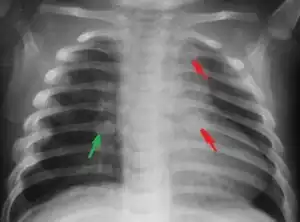
Psychosocial and Related Evaluation Multiple rib fractures in an infant secondary to child abuse. Skeletal survey for all children < 2 years of age, non-verbal, or severe developmental delay. Note: Follow-up skeletal survey should be performed within 10 to 14 days
Skull AP and lateral view (left and right)
Chest AP and lateral viewRight and left oblique of the chest
AP of the abdomen to include pelvis and hips
AP and lateral spine to include cervical, thoracic, and lumbar vertebrae
AP bilateral humerus
AP bilateral forearms
AP bilateral femurs
AP bilateral tibia and fibula
Posterior view of the hands
Dorsoplantar view of the feet
Head CT without contrast for any child < 1 year with suspicion of abuse or >1 year with concerning signs of head traumaTrauma labs: CBC, CMP, PT, PTT, lipase, and urinalysis (looking for blood; use bag specimen). Consider urine tox screen
Consider CPK and platelet function studies if extensive bruising is present
If trauma labs are abnormal (AST or ALT > 80, lipase > 100), obtain a CT of abdomen/pelvis with IV contrast
Consider a dilated fundoscopic exam if under 2 years
Photograph injuries
Obtain a social work consult Inpatient Workup[ 2] Ophtho consult for retinal hemorrhages
CBC
CMP, Mg, phos
PT/INR/aPTT, fibrinogen
PTH, iCa, 25-hydroxy-Vit D, 1,25-dihydroxy-Vit D
vW panel (vW AT, ristocetin cofactors, factor VIII) Management Treat injuries as indicated
Keep alleged perpetrator separate from the patient if possible and/or keep patient supervised at all times
Report abuse to the appropriate state child protection authority Disposition Admit for medical treatment or if any question of child's safety See Also External Links References
↑ Mojica, Michael. 2015. PEM Guides. NYU Langone Health.
↑ Children's Hospital of Georgia NAT Workup Protocol. Medical College of Georgia at Augusta University. Last reviewed 2016.